
How Biomemory Integrates commec to Ensure Biosecurity in a Non-Biological Application of DNA Synthesis
Biomemory, an innovative DNA data storage company and one of the board co-chairs of the DNA Data Storage Alliance (DDSA) part of the SNIA (Storage Networking Association), operates at the forefront of a field that repurposes the chemistry of life as a medium for digital information. As DNA data storage scales towards commercial viability, Biomemory recognized the need to proactively address biosecurity risks, even in a context where DNA is never intended for biological expression, and turned to Commec to meet it.
The Challenge: Biosecurity Screening for a Non-Biological Application
The global DNA synthesis industry is making significant progress in developing biosecurity screening practices to prevent the misuse of synthetic nucleic acids. However, DNA data storage presents a fundamentally different use case and very specific challenges.
Unlike DNA synthesized for life sciences applications, the generated synthetic DNA that make up a DNA data storage pool are designed only as a digital information storage molecule. They have no purpose of encoding proteins, initiating biological functions, or interacting with cells or any living organism. Still, the scale of DNA data storage creates the biosecurity challenge where a single storage pool may contain billions of unique DNA sequences, many orders of magnitude more than what can be found in typical biological research. Screening each of these sequences individually against pathogen and toxin databases, as is generally required under existing biosecurity frameworks, is neither practically nor economically feasible.
In parallel, the regulatory landscape is evolving, though it is more nuanced than a blanket duty to screen. The US OSTP Framework for Nucleic Acid Synthesis Screening states that providers should screen sequences longer than 50 base pairs, a threshold that effectively includes DNA data storage pools. In Europe, the upcoming EU Biotech Act is expected to address synthetic nucleic acid screening with mandatory language. Crucially, though, there is no explicit requirement to screen every synthetic sequence: under the draft, the obligation attaches only where a product contains a “sequence of concern” (SOC), defined in Annex I as a stretch of at least 50 nucleotides that matches the sequence of a dangerous agent. A provider that can guarantee its products contain no such SOC therefore falls outside the per-order screening obligation altogether.
The DNA Data Storage Alliance has engaged in this process directly. Its October 2025 Position on Biosecurity Regulation for DNA data Storage rests on two guiding principles. First, in DNA data storage the molecule serves only as an information-storage polymer with no intended biological function, so the risk of misuse can be controlled at any layer of the encoding, synthesis, and storage process. Second, exhaustive SOC screening of every sequence is neither practically nor economically feasible at data-storage scale, which runs many orders of magnitude beyond conventional biological research; and certain synthesis and encoding techniques can remove the need for it altogether by guaranteeing that no SOC can be produced.
The question Biomemory had to answer to be aligned with its values and to minimize the regulatory stringency on the DNA writing, storage, reading and logistic activities while following existing frameworks, was how to implement a screening approach that was robust, operationally possible, and aligned with best practices for their unique application.
The Solution: Using Commec to Guarantee SOC-Free Encoding
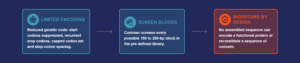
Biomemory’s approach relies on the key insight mentioned in the DDSA’s biosecurity position: certain encoding and synthesis techniques can remove the need for exhaustive sequence-level screening by guaranteeing that no SOC can be produced in the first place. Rather than screening every synthetic DNA sequence at the point of synthesis, an impossible task at the roughly 250 zettabytes of data the field anticipates, Biomemory builds biosecurity into the encoding itself, drawing on one of the safeguards the DDSA describes. It uses trusted synthesis that assembles data from a defined library of pre-screened DNA blocks. These DNA blocks are designed such that start codons are suppressed and multiple stop codons are incorporated to address all 6 frames once assembled to form DNA data strand. Biomemory uses commec to screen every possible combination of blocks from that library to generate 150 to 200-base-pair DNA fragments, confirming that none is a SOC. The output is therefore bio-secure by design. This approach aligns with how CATALOG, a Boston-based company from which the assets were recently acquired by Biomemory, used commec.
More broadly, the DDSA sets out four complementary safeguards: trusted synthesis, trusted storage, trusted codecs and trusted parties, that regulators and providers can combine as the situation requires. Biomemory’s pipeline that uses commec rests on the first one only.
The Outcome: Robust Screening in a Complex Technical Environment
The tools had been developed to be easily accessible and deployable on internal infrastructures thus offering proper security and independence to analyze proprietary sequences. These aspects are supported by user’s feedback:
Commec was easy to set up and deploy, even for non-experts in coding, thanks to a very clear and detailed GitHub page. It allowed me to smoothly analyze over 350 sequences locally, from my laptop.” cited by Gabrielle Schanne; and “Commec is great for analyzing sequences without sending them over the internet, and what is done is transparent thanks to its open-source nature.” highlighted by Gilles Bardoux. It supports design build test learn cycle (DBTL) to generate and validate “biosecured by design” bioblocks used in our DNA synthesis process.
By shifting the point of screening to upfront of the encoding step, at the synthesis design level rather than to each synthesized sequence, Biomemory avoids the computational blockage of sequence-by-sequence analysis while still aligning with screening frameworks. The result is a pipeline that is proportionate to the biosecurity risk posed by DNA data storage and capable of operating with large data volumes, without compromising on safety or regulatory alignment.
What This Signals for the DNA Data Storage Industry
The integration of commec into Biomemory’s DNA synthesis and encoding validation process shows that their DNA data storage pipeline is biosecure by design. This provides confidence to customers, partners, and regulators that responsible innovation is built into the company’s core operations.
Biomemory’s example shows that Biosecurity is achievable and recommended for DNA data storage companies, and that enabling tools such as commec are already available. As regulatory frameworks continue to evolve, similar companies would do well to act now rather than wait, and IBBIS invites other DNA data storage providers to explore how commec can support their biosecurity strategy.
Working with IBBIS
IBBIS supports DNA synthesis providers and, increasingly, DNA data storage companies operating across borders. Commec is freely available for providers seeking alignment with the US Framework, UK screening guidance on synthetic nucleic acids, and broader multi-jurisdictional compliance in major bioeconomies such as the European Union and the BRICS. The DNA Data Storage Alliance is also a valuable forum for engaging with these questions across the industry. If you are weighing how the evolving US and EU requirements apply to your own pipeline, IBBIS is glad to help you make sense of the landscape and to explore whether commec fits your workflow.
About Biomemory
Biomemory is a French deeptech company building the foundations of Molecular IT, a new information tier that uses DNA to store, search and ultimately compute data. Spun out of research from CNRS and Sorbonne University, Biomemory integrates molecular biology, biochemistry, hardware, software and industrial production into a single end-to-end platform. The company is bringing DNA data storage from the laboratory to commercial applications, starting with sovereign preservation and recovery and expanding toward large-scale archival storage, molecular search and compute.